
Today is the four-year anniversary of my dad’s passing.
This year, as I reflect on his life, I’d like to challenge the way we deal with grief. Well, maybe not grief, but more specifically, those who grieve. It’s an uncomfortable topic.
We all have the same sinking feeling in our chest when we hear the news of someone losing a family member or close friend. What we do next is interesting: we take complex feelings and sympathetic pain and often translate it into a formula.
You’ve seen the script before: “I’m sorry for your loss. You and your family are in my thoughts and prayers. Please let me know if there’s anything I can do.”
The first person in human history who ever dropped this phrase on a grieving friend really crushed it: powerful, well-meaning, and concise. But, we’ve all since plagiarized those words into irrelevance, or at least tempered sympathy. It’s almost ingrained in us, but not because we don’t care or want to take the easy route by sticking to a patented script.
What do you say to a person who has had his or her world turned upside down? Even for our closest family and friends, what could we possibly say to temporarily lift them above the chaos of loss? The difficulty of that only seems to multiply once it’s an acquaintance or distant friend. Words are tough.
But, what if true sympathy doesn’t use words at all? Interestingly enough, my view was changed forever by an unlikely source: a little bakery down the road.
After my dad’s retirement, he almost immediately became a man of structure. Not to say that he was living completely free and easy when he was gainfully employed, but something in his AARP-wired brain told him that he needed a routine to fill the working void, stat.
It didn’t take long for him to establish one. (Almost) every morning, he would start his day by stopping at our local bakery, Ridley’s. He quickly became known at the cafe for the same daily order: a carrot cream cheese muffin, black coffee, and that day’s Detroit Free Press.
After exchanging pleasantries with his fellow pastry enjoyers, he would pull up a chair at the same table closest to the door, open the paper, and start reading the latest sports columns. In 2021/2022, it was a sad state of affairs for Detroit sports, so I can’t imagine the reading was all that enjoyable, but he loved it. Up until the day he passed, this was his routine; there was simply no other way for him to start the day.
The morning after his death, our family friends stopped into Ridley’s, looking to pick up some treats. That’s when they noticed it – the seat by the door was empty as they expected, but my dad was the only thing missing from his daily routine.
At my dad’s usual table, sat a carrot cream cheese muffin, fresh black coffee, Detroit Free Press newspaper, and a sign reading:
“RESERVED FOR GREG FLEWELLING – Your smile and friendship will be missed.”
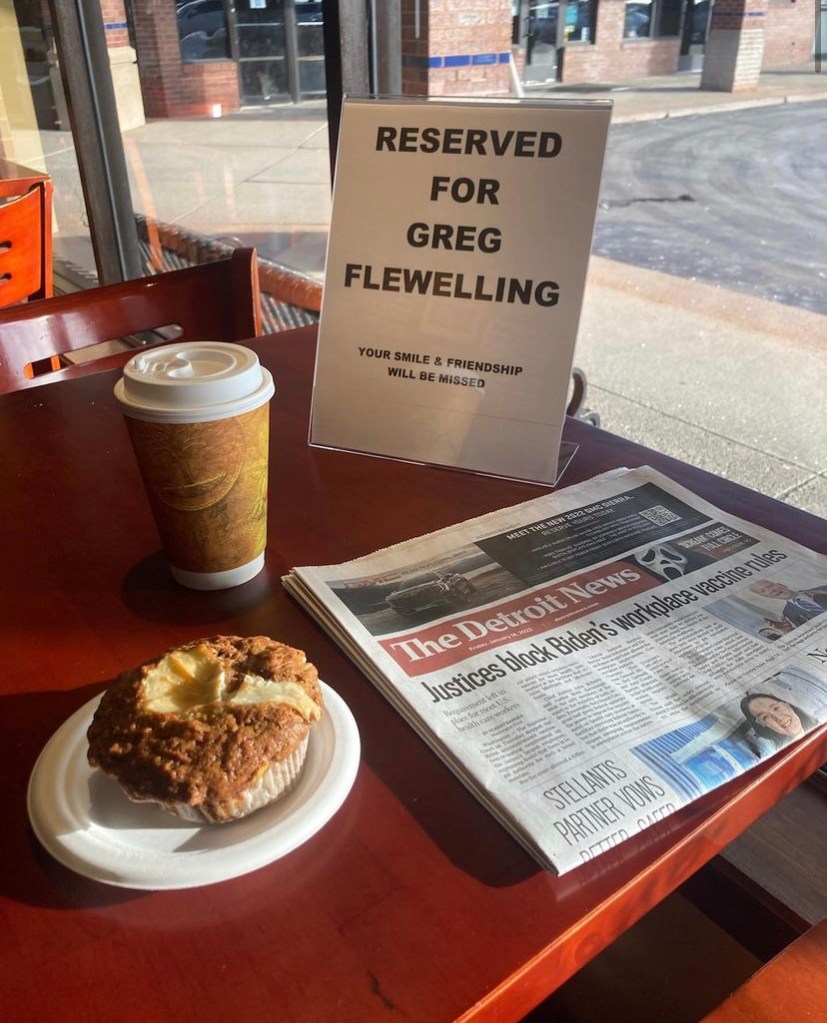
When our friends sent us a photo of the tribute, we were stunned. The bakery didn’t ask for our blessing or send it directly to us to make sure we knew what they were up to; they knew they had lost someone who became a part of their family, and they unleashed a beautiful act of love.
But, it didn’t stop there.
In the days that followed, family and friends stopped by the bakery and noticed something peculiar: a fresh muffin, hot coffee, and the next day’s newspaper were put out to replace the ones from the day before. It would have been a touching tribute to leave the original items for a couple of days, but love doesn’t do what’s easy.
When they put out his usual order the first day, we heard their message: my dad was loved.
When they did it a second and third day, we heard their message in a new way: we are loved.
Ridley’s, and so many others, taught a masterclass in dealing with those who grieve. An act done for those hurting, while nice on the surface, speaks a much greater Godly truth: “You are loved, and we are here with you in your grief.”
While I’m not a licensed counselor, what I do know is that Jesus gave us this blueprint thousands of years ago. The loss of my dad awoke me to this lesson, but what I’m describing isn’t new. Jesus lived this example countless times with the grief He came across, especially with those close to Him.
In a well-known story in the Bible, Jesus had a friend named Lazarus who died. When Jesus came to the tomb, He was greatly troubled and overcome with emotion. Jesus wept. While a seemingly normal reaction in the context of human life, it’s unbelievably strange if you know the end of the story: Jesus raises Lazarus from the dead shortly after.
There’s a reason Jesus was moved to tears. It was a guide for us; to experience the weight of other’s grief and take their burden as our own. No words needed. Jesus doesn’t say a generic set of condolences; He sits in the grief along with us and reminds us that we are loved more than we will ever know.
I still miss my dad today as much as I did four years ago. I often pass by the cemetery where my dad was laid to rest and think about how much I wish he was still here; how much I want to tell him about the Lions, or my brother and I playing doubles together in tennis, or all of the life that we’ve lived since he’s been gone. The void only grows when looking to the future and knowing he’ll be missing from all of life’s big events. In those moments, it’s easy to think, “I’ll miss him forever,” but it’s just not true.
God’s promises are too good for that to be true. To know Jesus is to know the only One who has defeated the grave, and with that, comes hope and expectant joy of everlasting life. It’s to know that this life is temporary because of the great sacrifice of our Savior, and by trusting in Him, we’ll be reunited with our fellow believers in God’s glory. So, while I’ll love my dad forever, I know I’ll only miss him during my time on Earth.
I have quite a few friends still picking up the pieces of heartbreaking loss. I won’t pretend to know the uniqueness that comes with individual grief, but I do know the solution to our pain is the same: a relationship with Jesus. And, the first step to that is easier than you may think.
Maybe that’s a prayer to God who hasn’t heard from you in a while (or ever). Maybe it’s dusting off your Bible to read a few verses. Maybe it’s stepping into an unfamiliar church on a Sunday morning. The beautiful part is that the Bible mentions that God delights in small beginnings. Before you know it, those small steps will lead you to the foot of the Cross.
At the end of it all, I’ve often wondered what it looks like to know you’ve made an impact loving God and loving others. I now know that it looks like an empty seat by the door of a little bakery down the road.
Love you forever, Dad.
-E

 esflewelling.com
What a loving tribute to your dad and tribute to our loving Savior, Eric!
LikeLike
Such an incredibly well-thought out tribute to your dad, Eric. Beautiful, comforting truths. You are gifted.
LikeLike